
Kenya wins three-year AGOA extension, securing jobs
Source: The Standard
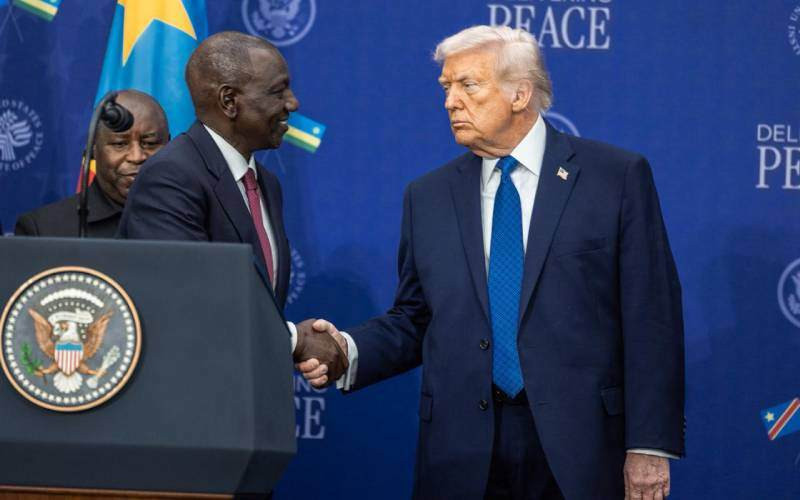
President William Ruto and President Donald Trump during the signing of a peace deal between DRC and Rwanda at the Donald J. Trump United States Institute of Peace in Washington, D.C., the United States. [PCS]
Kenya has secured a three-year extension of the African Growth and Opportunity Act (AGOA) after the United States House of Representatives passed a Bill.The move eases uncertainty that had clouded the country’s export sector and putting jobs at the centre of the decision.Kenya was designated an AGOA-eligible country on October 2, 2000, and became eligible for apparel provisions on January 18, 2001.Follow The Standard
channel
on WhatsAppThe pact has given Kenya duty-free access to the US market for thousands of products and has helped grow its textile, apparel, and other export sectors over the past 25 years.AGOA is a US trade preference law that gives eligible sub-Saharan African countries duty-free access to the US market for more than 6,000 products.It has helped boost exports from Africa and supported job creation and industrial expansion across the continent.The extension secures continued duty-free access to the US market for eligible African countries, a move that directly affects Kenya’s textile and apparel firms operating in Export Processing Zones (EPZs).The sector employs more than 80,000 people directly and about 250,000 indirectly, according to the Ministry of Investments, Trade and Industry.“The uncertainty that had previously engulfed the sector will now give way to renewed confidence and expansion,” said Cabinet Secretary Lee Kinyanjui.Kinyanjui said the government now plans to push beyond textiles and apparel by exporting more products under the AGOA framework to widen job creation and boost wealth generation.“As a Ministry, we aim to grow exports of additional products under the AGOA framework beyond textiles, ensuring that Kenya fully leverages this opportunity to create jobs and generate wealth,” he added.At the same time, Kenya and the US are holding talks on a bilateral trade agreement expected to cover other sectors and strengthen long-standing ties between the two countries.The talks featured during President William Ruto’s recent visit to Washington, D.C., where Kenya sought enhanced market access to the US.Kenya’s main exports to the US include textiles and apparel, coffee, tea, horticultural products and tourism services.Stay informed. Subscribe to our newsletterBy clicking on theSIGN UPbutton, you agree to ourTerms & Conditionsand thePrivacy PolicySIGN UPExpanding the export basket remains a priority under the government’s broader economic agenda, the ministry said.Stay Informed, Stay Empowered: Download the Standard ePaper App!The AGOA extension still requires approval by the US Senate before it becomes law.
The move eases uncertainty that had clouded the country’s export sector and putting jobs at the centre of the decision.Kenya was designated an AGOA-eligible country on October 2, 2000, and became eligible for apparel provisions on January 18, 2001.Follow The Standard
channel
on WhatsAppThe pact has given Kenya duty-free access to the US market for thousands of products and has helped grow its textile, apparel, and other export sectors over the past 25 years.AGOA is a US trade preference law that gives eligible sub-Saharan African countries duty-free access to the US market for more than 6,000 products.It has helped boost exports from Africa and supported job creation and industrial expansion across the continent.The extension secures continued duty-free access to the US market for eligible African countries, a move that directly affects Kenya’s textile and apparel firms operating in Export Processing Zones (EPZs).The sector employs more than 80,000 people directly and about 250,000 indirectly, according to the Ministry of Investments, Trade and Industry.“The uncertainty that had previously engulfed the sector will now give way to renewed confidence and expansion,” said Cabinet Secretary Lee Kinyanjui.Kinyanjui said the government now plans to push beyond textiles and apparel by exporting more products under the AGOA framework to widen job creation and boost wealth generation.“As a Ministry, we aim to grow exports of additional products under the AGOA framework beyond textiles, ensuring that Kenya fully leverages this opportunity to create jobs and generate wealth,” he added.At the same time, Kenya and the US are holding talks on a bilateral trade agreement expected to cover other sectors and strengthen long-standing ties between the two countries.The talks featured during President William Ruto’s recent visit to Washington, D.C., where Kenya sought enhanced market access to the US.Kenya’s main exports to the US include textiles and apparel, coffee, tea, horticultural products and tourism services.Stay informed. Subscribe to our newsletterBy clicking on theSIGN UPbutton, you agree to ourTerms & Conditionsand thePrivacy PolicySIGN UPExpanding the export basket remains a priority under the government’s broader economic agenda, the ministry said.Stay Informed, Stay Empowered: Download the Standard ePaper App!The AGOA extension still requires approval by the US Senate before it becomes law.
Kenya was designated an AGOA-eligible country on October 2, 2000, and became eligible for apparel provisions on January 18, 2001.Follow The Standard
channel
on WhatsAppThe pact has given Kenya duty-free access to the US market for thousands of products and has helped grow its textile, apparel, and other export sectors over the past 25 years.AGOA is a US trade preference law that gives eligible sub-Saharan African countries duty-free access to the US market for more than 6,000 products.It has helped boost exports from Africa and supported job creation and industrial expansion across the continent.The extension secures continued duty-free access to the US market for eligible African countries, a move that directly affects Kenya’s textile and apparel firms operating in Export Processing Zones (EPZs).The sector employs more than 80,000 people directly and about 250,000 indirectly, according to the Ministry of Investments, Trade and Industry.“The uncertainty that had previously engulfed the sector will now give way to renewed confidence and expansion,” said Cabinet Secretary Lee Kinyanjui.Kinyanjui said the government now plans to push beyond textiles and apparel by exporting more products under the AGOA framework to widen job creation and boost wealth generation.“As a Ministry, we aim to grow exports of additional products under the AGOA framework beyond textiles, ensuring that Kenya fully leverages this opportunity to create jobs and generate wealth,” he added.At the same time, Kenya and the US are holding talks on a bilateral trade agreement expected to cover other sectors and strengthen long-standing ties between the two countries.The talks featured during President William Ruto’s recent visit to Washington, D.C., where Kenya sought enhanced market access to the US.Kenya’s main exports to the US include textiles and apparel, coffee, tea, horticultural products and tourism services.Stay informed. Subscribe to our newsletterBy clicking on theSIGN UPbutton, you agree to ourTerms & Conditionsand thePrivacy PolicySIGN UPExpanding the export basket remains a priority under the government’s broader economic agenda, the ministry said.Stay Informed, Stay Empowered: Download the Standard ePaper App!The AGOA extension still requires approval by the US Senate before it becomes law.
The pact has given Kenya duty-free access to the US market for thousands of products and has helped grow its textile, apparel, and other export sectors over the past 25 years.AGOA is a US trade preference law that gives eligible sub-Saharan African countries duty-free access to the US market for more than 6,000 products.It has helped boost exports from Africa and supported job creation and industrial expansion across the continent.The extension secures continued duty-free access to the US market for eligible African countries, a move that directly affects Kenya’s textile and apparel firms operating in Export Processing Zones (EPZs).The sector employs more than 80,000 people directly and about 250,000 indirectly, according to the Ministry of Investments, Trade and Industry.“The uncertainty that had previously engulfed the sector will now give way to renewed confidence and expansion,” said Cabinet Secretary Lee Kinyanjui.Kinyanjui said the government now plans to push beyond textiles and apparel by exporting more products under the AGOA framework to widen job creation and boost wealth generation.“As a Ministry, we aim to grow exports of additional products under the AGOA framework beyond textiles, ensuring that Kenya fully leverages this opportunity to create jobs and generate wealth,” he added.At the same time, Kenya and the US are holding talks on a bilateral trade agreement expected to cover other sectors and strengthen long-standing ties between the two countries.The talks featured during President William Ruto’s recent visit to Washington, D.C., where Kenya sought enhanced market access to the US.Kenya’s main exports to the US include textiles and apparel, coffee, tea, horticultural products and tourism services.Stay informed. Subscribe to our newsletterBy clicking on theSIGN UPbutton, you agree to ourTerms & Conditionsand thePrivacy PolicySIGN UPExpanding the export basket remains a priority under the government’s broader economic agenda, the ministry said.Stay Informed, Stay Empowered: Download the Standard ePaper App!The AGOA extension still requires approval by the US Senate before it becomes law.
AGOA is a US trade preference law that gives eligible sub-Saharan African countries duty-free access to the US market for more than 6,000 products.It has helped boost exports from Africa and supported job creation and industrial expansion across the continent.The extension secures continued duty-free access to the US market for eligible African countries, a move that directly affects Kenya’s textile and apparel firms operating in Export Processing Zones (EPZs).The sector employs more than 80,000 people directly and about 250,000 indirectly, according to the Ministry of Investments, Trade and Industry.“The uncertainty that had previously engulfed the sector will now give way to renewed confidence and expansion,” said Cabinet Secretary Lee Kinyanjui.Kinyanjui said the government now plans to push beyond textiles and apparel by exporting more products under the AGOA framework to widen job creation and boost wealth generation.“As a Ministry, we aim to grow exports of additional products under the AGOA framework beyond textiles, ensuring that Kenya fully leverages this opportunity to create jobs and generate wealth,” he added.At the same time, Kenya and the US are holding talks on a bilateral trade agreement expected to cover other sectors and strengthen long-standing ties between the two countries.The talks featured during President William Ruto’s recent visit to Washington, D.C., where Kenya sought enhanced market access to the US.Kenya’s main exports to the US include textiles and apparel, coffee, tea, horticultural products and tourism services.Stay informed. Subscribe to our newsletterBy clicking on theSIGN UPbutton, you agree to ourTerms & Conditionsand thePrivacy PolicySIGN UPExpanding the export basket remains a priority under the government’s broader economic agenda, the ministry said.Stay Informed, Stay Empowered: Download the Standard ePaper App!The AGOA extension still requires approval by the US Senate before it becomes law.
It has helped boost exports from Africa and supported job creation and industrial expansion across the continent.The extension secures continued duty-free access to the US market for eligible African countries, a move that directly affects Kenya’s textile and apparel firms operating in Export Processing Zones (EPZs).The sector employs more than 80,000 people directly and about 250,000 indirectly, according to the Ministry of Investments, Trade and Industry.“The uncertainty that had previously engulfed the sector will now give way to renewed confidence and expansion,” said Cabinet Secretary Lee Kinyanjui.Kinyanjui said the government now plans to push beyond textiles and apparel by exporting more products under the AGOA framework to widen job creation and boost wealth generation.“As a Ministry, we aim to grow exports of additional products under the AGOA framework beyond textiles, ensuring that Kenya fully leverages this opportunity to create jobs and generate wealth,” he added.At the same time, Kenya and the US are holding talks on a bilateral trade agreement expected to cover other sectors and strengthen long-standing ties between the two countries.The talks featured during President William Ruto’s recent visit to Washington, D.C., where Kenya sought enhanced market access to the US.Kenya’s main exports to the US include textiles and apparel, coffee, tea, horticultural products and tourism services.Stay informed. Subscribe to our newsletterBy clicking on theSIGN UPbutton, you agree to ourTerms & Conditionsand thePrivacy PolicySIGN UPExpanding the export basket remains a priority under the government’s broader economic agenda, the ministry said.Stay Informed, Stay Empowered: Download the Standard ePaper App!The AGOA extension still requires approval by the US Senate before it becomes law.
The extension secures continued duty-free access to the US market for eligible African countries, a move that directly affects Kenya’s textile and apparel firms operating in Export Processing Zones (EPZs).The sector employs more than 80,000 people directly and about 250,000 indirectly, according to the Ministry of Investments, Trade and Industry.“The uncertainty that had previously engulfed the sector will now give way to renewed confidence and expansion,” said Cabinet Secretary Lee Kinyanjui.Kinyanjui said the government now plans to push beyond textiles and apparel by exporting more products under the AGOA framework to widen job creation and boost wealth generation.“As a Ministry, we aim to grow exports of additional products under the AGOA framework beyond textiles, ensuring that Kenya fully leverages this opportunity to create jobs and generate wealth,” he added.At the same time, Kenya and the US are holding talks on a bilateral trade agreement expected to cover other sectors and strengthen long-standing ties between the two countries.The talks featured during President William Ruto’s recent visit to Washington, D.C., where Kenya sought enhanced market access to the US.Kenya’s main exports to the US include textiles and apparel, coffee, tea, horticultural products and tourism services.Stay informed. Subscribe to our newsletterBy clicking on theSIGN UPbutton, you agree to ourTerms & Conditionsand thePrivacy PolicySIGN UPExpanding the export basket remains a priority under the government’s broader economic agenda, the ministry said.Stay Informed, Stay Empowered: Download the Standard ePaper App!The AGOA extension still requires approval by the US Senate before it becomes law.
The sector employs more than 80,000 people directly and about 250,000 indirectly, according to the Ministry of Investments, Trade and Industry.“The uncertainty that had previously engulfed the sector will now give way to renewed confidence and expansion,” said Cabinet Secretary Lee Kinyanjui.Kinyanjui said the government now plans to push beyond textiles and apparel by exporting more products under the AGOA framework to widen job creation and boost wealth generation.“As a Ministry, we aim to grow exports of additional products under the AGOA framework beyond textiles, ensuring that Kenya fully leverages this opportunity to create jobs and generate wealth,” he added.At the same time, Kenya and the US are holding talks on a bilateral trade agreement expected to cover other sectors and strengthen long-standing ties between the two countries.The talks featured during President William Ruto’s recent visit to Washington, D.C., where Kenya sought enhanced market access to the US.Kenya’s main exports to the US include textiles and apparel, coffee, tea, horticultural products and tourism services.Stay informed. Subscribe to our newsletterBy clicking on theSIGN UPbutton, you agree to ourTerms & Conditionsand thePrivacy PolicySIGN UPExpanding the export basket remains a priority under the government’s broader economic agenda, the ministry said.Stay Informed, Stay Empowered: Download the Standard ePaper App!The AGOA extension still requires approval by the US Senate before it becomes law.
“The uncertainty that had previously engulfed the sector will now give way to renewed confidence and expansion,” said Cabinet Secretary Lee Kinyanjui.Kinyanjui said the government now plans to push beyond textiles and apparel by exporting more products under the AGOA framework to widen job creation and boost wealth generation.“As a Ministry, we aim to grow exports of additional products under the AGOA framework beyond textiles, ensuring that Kenya fully leverages this opportunity to create jobs and generate wealth,” he added.At the same time, Kenya and the US are holding talks on a bilateral trade agreement expected to cover other sectors and strengthen long-standing ties between the two countries.The talks featured during President William Ruto’s recent visit to Washington, D.C., where Kenya sought enhanced market access to the US.Kenya’s main exports to the US include textiles and apparel, coffee, tea, horticultural products and tourism services.Stay informed. Subscribe to our newsletterBy clicking on theSIGN UPbutton, you agree to ourTerms & Conditionsand thePrivacy PolicySIGN UPExpanding the export basket remains a priority under the government’s broader economic agenda, the ministry said.Stay Informed, Stay Empowered: Download the Standard ePaper App!The AGOA extension still requires approval by the US Senate before it becomes law.
Kinyanjui said the government now plans to push beyond textiles and apparel by exporting more products under the AGOA framework to widen job creation and boost wealth generation.“As a Ministry, we aim to grow exports of additional products under the AGOA framework beyond textiles, ensuring that Kenya fully leverages this opportunity to create jobs and generate wealth,” he added.At the same time, Kenya and the US are holding talks on a bilateral trade agreement expected to cover other sectors and strengthen long-standing ties between the two countries.The talks featured during President William Ruto’s recent visit to Washington, D.C., where Kenya sought enhanced market access to the US.Kenya’s main exports to the US include textiles and apparel, coffee, tea, horticultural products and tourism services.Stay informed. Subscribe to our newsletterBy clicking on theSIGN UPbutton, you agree to ourTerms & Conditionsand thePrivacy PolicySIGN UPExpanding the export basket remains a priority under the government’s broader economic agenda, the ministry said.Stay Informed, Stay Empowered: Download the Standard ePaper App!The AGOA extension still requires approval by the US Senate before it becomes law.
“As a Ministry, we aim to grow exports of additional products under the AGOA framework beyond textiles, ensuring that Kenya fully leverages this opportunity to create jobs and generate wealth,” he added.At the same time, Kenya and the US are holding talks on a bilateral trade agreement expected to cover other sectors and strengthen long-standing ties between the two countries.The talks featured during President William Ruto’s recent visit to Washington, D.C., where Kenya sought enhanced market access to the US.Kenya’s main exports to the US include textiles and apparel, coffee, tea, horticultural products and tourism services.Stay informed. Subscribe to our newsletterBy clicking on theSIGN UPbutton, you agree to ourTerms & Conditionsand thePrivacy PolicySIGN UPExpanding the export basket remains a priority under the government’s broader economic agenda, the ministry said.Stay Informed, Stay Empowered: Download the Standard ePaper App!The AGOA extension still requires approval by the US Senate before it becomes law.
At the same time, Kenya and the US are holding talks on a bilateral trade agreement expected to cover other sectors and strengthen long-standing ties between the two countries.The talks featured during President William Ruto’s recent visit to Washington, D.C., where Kenya sought enhanced market access to the US.Kenya’s main exports to the US include textiles and apparel, coffee, tea, horticultural products and tourism services.Stay informed. Subscribe to our newsletterBy clicking on theSIGN UPbutton, you agree to ourTerms & Conditionsand thePrivacy PolicySIGN UPExpanding the export basket remains a priority under the government’s broader economic agenda, the ministry said.Stay Informed, Stay Empowered: Download the Standard ePaper App!The AGOA extension still requires approval by the US Senate before it becomes law.
The talks featured during President William Ruto’s recent visit to Washington, D.C., where Kenya sought enhanced market access to the US.Kenya’s main exports to the US include textiles and apparel, coffee, tea, horticultural products and tourism services.Stay informed. Subscribe to our newsletterBy clicking on theSIGN UPbutton, you agree to ourTerms & Conditionsand thePrivacy PolicySIGN UPExpanding the export basket remains a priority under the government’s broader economic agenda, the ministry said.Stay Informed, Stay Empowered: Download the Standard ePaper App!The AGOA extension still requires approval by the US Senate before it becomes law.
Kenya’s main exports to the US include textiles and apparel, coffee, tea, horticultural products and tourism services.Stay informed. Subscribe to our newsletterBy clicking on theSIGN UPbutton, you agree to ourTerms & Conditionsand thePrivacy PolicySIGN UPExpanding the export basket remains a priority under the government’s broader economic agenda, the ministry said.Stay Informed, Stay Empowered: Download the Standard ePaper App!The AGOA extension still requires approval by the US Senate before it becomes law.
Expanding the export basket remains a priority under the government’s broader economic agenda, the ministry said.Stay Informed, Stay Empowered: Download the Standard ePaper App!The AGOA extension still requires approval by the US Senate before it becomes law.
The AGOA extension still requires approval by the US Senate before it becomes law.
Subscribe to our newsletter and stay updated on the latest developments and special
offers!
Pick your favourite topics below for a tailor made homepage just for you