
'Execution-style killings' in Tanzania election crackdown: report
Source: The Standard
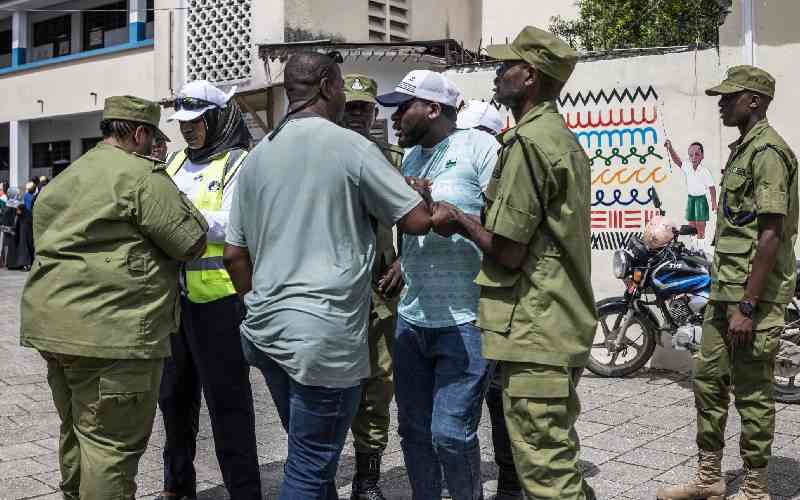
Tanzanian police officers detain a man accused by electoral officials of attempting to taint the voting process at a polling station in Stone Town on October 29, 2025, during Tanzania’s presidential elections.[AFP]
Tanzanian security forces fired on fleeing protesters and carried out "execution-style killings" during election unrest last year, according to a report released Monday that verified online images alongside drone and satellite footage.The Centre for Information Resilience (CIR), a UK-based independent organisation that carries out digital investigations, collected and analysed evidence from the unrest that broke out during the October 29 election in Tanzania.Violent protests erupted after the government of President Samia Suluhu Hassan was accused of barring her main opponents and carrying out a spate of abductions and murders ahead of the election.Follow The Standard
channel
on WhatsAppThe opposition says at least 2,000 people were killed by security forces indays of unrestthat was hard to document as the government had blocked foreign journalists from entering the country, and imposed a curfew and total internet blackout for several days.Hassan was declared the winner with 98 percent of the vote. She justified the killings, saying it was necessary to prevent the overthrow of the government and that no excessive force was used.But CIR analysed 185 images and videos dated from October 29 to November 4 when the curfew was lifted, as well as satellite imagery and drone footage."CIR verified the repeated use of live ammunition by security forces and plain-clothed armed men, resulting in casualties," the report said.It "identified possible mass graves through satellite imagery and verified large piles of bodies" within user-generated content, as well as images showing civilians "assaulted" and "humiliated".The report also provided a map of incidents where they had verified images of protesters "vandalising buildings, starting fires and throwing rocks at police officers".The evidence includes verified footage of "the shooting of fleeing protesters, including a pregnant woman, near the A104 highway" in Arusha, and night-time footage from Mwanza that "shows apparent execution-style killings away from major protest sites".In one example, drone footage of Dar es Salaam shared with CIR showed "a white truck chasing civilians, before its occupants dismount and begin shooting indiscriminately toward nearby houses".The government did not respond to repeated requests for comment from AFP.AFP has previously spoken with a doctor at a major hospital in Dar es Salaam who said hundreds of injured patients and corpses were taken from his facility to secret locations at the height of the unrest.CIR found evidence of newly disturbed earth between November 2 and 5 at Kondo cemetery near Dar es Salaam -- a location that a senior government official, angry over the crackdown, had told AFP was the possible site of a mass grave. The location was also identified in a CNN investigation.Stay informed. Subscribe to our newsletterBy clicking on theSIGN UPbutton, you agree to ourTerms & Conditionsand thePrivacy PolicySIGN UPCIR satellite imagery showed temporary structures built on the grounds of the city's Kivule District Hospital during the unrest, supporting reports that amakeshift mortuary buildingwas hastily constructed there to handle the large influx of casualties.Stay Informed, Stay Empowered: Download the Standard ePaper App!Signs of another possible mass grave at Tengeru agricultural college in Arusha were also identified by CIR.Follow The Standard
channel
on WhatsApp
The Centre for Information Resilience (CIR), a UK-based independent organisation that carries out digital investigations, collected and analysed evidence from the unrest that broke out during the October 29 election in Tanzania.Violent protests erupted after the government of President Samia Suluhu Hassan was accused of barring her main opponents and carrying out a spate of abductions and murders ahead of the election.Follow The Standard
channel
on WhatsAppThe opposition says at least 2,000 people were killed by security forces indays of unrestthat was hard to document as the government had blocked foreign journalists from entering the country, and imposed a curfew and total internet blackout for several days.Hassan was declared the winner with 98 percent of the vote. She justified the killings, saying it was necessary to prevent the overthrow of the government and that no excessive force was used.But CIR analysed 185 images and videos dated from October 29 to November 4 when the curfew was lifted, as well as satellite imagery and drone footage."CIR verified the repeated use of live ammunition by security forces and plain-clothed armed men, resulting in casualties," the report said.It "identified possible mass graves through satellite imagery and verified large piles of bodies" within user-generated content, as well as images showing civilians "assaulted" and "humiliated".The report also provided a map of incidents where they had verified images of protesters "vandalising buildings, starting fires and throwing rocks at police officers".The evidence includes verified footage of "the shooting of fleeing protesters, including a pregnant woman, near the A104 highway" in Arusha, and night-time footage from Mwanza that "shows apparent execution-style killings away from major protest sites".In one example, drone footage of Dar es Salaam shared with CIR showed "a white truck chasing civilians, before its occupants dismount and begin shooting indiscriminately toward nearby houses".The government did not respond to repeated requests for comment from AFP.AFP has previously spoken with a doctor at a major hospital in Dar es Salaam who said hundreds of injured patients and corpses were taken from his facility to secret locations at the height of the unrest.CIR found evidence of newly disturbed earth between November 2 and 5 at Kondo cemetery near Dar es Salaam -- a location that a senior government official, angry over the crackdown, had told AFP was the possible site of a mass grave. The location was also identified in a CNN investigation.Stay informed. Subscribe to our newsletterBy clicking on theSIGN UPbutton, you agree to ourTerms & Conditionsand thePrivacy PolicySIGN UPCIR satellite imagery showed temporary structures built on the grounds of the city's Kivule District Hospital during the unrest, supporting reports that amakeshift mortuary buildingwas hastily constructed there to handle the large influx of casualties.Stay Informed, Stay Empowered: Download the Standard ePaper App!Signs of another possible mass grave at Tengeru agricultural college in Arusha were also identified by CIR.Follow The Standard
channel
on WhatsApp
Violent protests erupted after the government of President Samia Suluhu Hassan was accused of barring her main opponents and carrying out a spate of abductions and murders ahead of the election.Follow The Standard
channel
on WhatsAppThe opposition says at least 2,000 people were killed by security forces indays of unrestthat was hard to document as the government had blocked foreign journalists from entering the country, and imposed a curfew and total internet blackout for several days.Hassan was declared the winner with 98 percent of the vote. She justified the killings, saying it was necessary to prevent the overthrow of the government and that no excessive force was used.But CIR analysed 185 images and videos dated from October 29 to November 4 when the curfew was lifted, as well as satellite imagery and drone footage."CIR verified the repeated use of live ammunition by security forces and plain-clothed armed men, resulting in casualties," the report said.It "identified possible mass graves through satellite imagery and verified large piles of bodies" within user-generated content, as well as images showing civilians "assaulted" and "humiliated".The report also provided a map of incidents where they had verified images of protesters "vandalising buildings, starting fires and throwing rocks at police officers".The evidence includes verified footage of "the shooting of fleeing protesters, including a pregnant woman, near the A104 highway" in Arusha, and night-time footage from Mwanza that "shows apparent execution-style killings away from major protest sites".In one example, drone footage of Dar es Salaam shared with CIR showed "a white truck chasing civilians, before its occupants dismount and begin shooting indiscriminately toward nearby houses".The government did not respond to repeated requests for comment from AFP.AFP has previously spoken with a doctor at a major hospital in Dar es Salaam who said hundreds of injured patients and corpses were taken from his facility to secret locations at the height of the unrest.CIR found evidence of newly disturbed earth between November 2 and 5 at Kondo cemetery near Dar es Salaam -- a location that a senior government official, angry over the crackdown, had told AFP was the possible site of a mass grave. The location was also identified in a CNN investigation.Stay informed. Subscribe to our newsletterBy clicking on theSIGN UPbutton, you agree to ourTerms & Conditionsand thePrivacy PolicySIGN UPCIR satellite imagery showed temporary structures built on the grounds of the city's Kivule District Hospital during the unrest, supporting reports that amakeshift mortuary buildingwas hastily constructed there to handle the large influx of casualties.Stay Informed, Stay Empowered: Download the Standard ePaper App!Signs of another possible mass grave at Tengeru agricultural college in Arusha were also identified by CIR.Follow The Standard
channel
on WhatsApp
The opposition says at least 2,000 people were killed by security forces indays of unrestthat was hard to document as the government had blocked foreign journalists from entering the country, and imposed a curfew and total internet blackout for several days.Hassan was declared the winner with 98 percent of the vote. She justified the killings, saying it was necessary to prevent the overthrow of the government and that no excessive force was used.But CIR analysed 185 images and videos dated from October 29 to November 4 when the curfew was lifted, as well as satellite imagery and drone footage."CIR verified the repeated use of live ammunition by security forces and plain-clothed armed men, resulting in casualties," the report said.It "identified possible mass graves through satellite imagery and verified large piles of bodies" within user-generated content, as well as images showing civilians "assaulted" and "humiliated".The report also provided a map of incidents where they had verified images of protesters "vandalising buildings, starting fires and throwing rocks at police officers".The evidence includes verified footage of "the shooting of fleeing protesters, including a pregnant woman, near the A104 highway" in Arusha, and night-time footage from Mwanza that "shows apparent execution-style killings away from major protest sites".In one example, drone footage of Dar es Salaam shared with CIR showed "a white truck chasing civilians, before its occupants dismount and begin shooting indiscriminately toward nearby houses".The government did not respond to repeated requests for comment from AFP.AFP has previously spoken with a doctor at a major hospital in Dar es Salaam who said hundreds of injured patients and corpses were taken from his facility to secret locations at the height of the unrest.CIR found evidence of newly disturbed earth between November 2 and 5 at Kondo cemetery near Dar es Salaam -- a location that a senior government official, angry over the crackdown, had told AFP was the possible site of a mass grave. The location was also identified in a CNN investigation.Stay informed. Subscribe to our newsletterBy clicking on theSIGN UPbutton, you agree to ourTerms & Conditionsand thePrivacy PolicySIGN UPCIR satellite imagery showed temporary structures built on the grounds of the city's Kivule District Hospital during the unrest, supporting reports that amakeshift mortuary buildingwas hastily constructed there to handle the large influx of casualties.Stay Informed, Stay Empowered: Download the Standard ePaper App!Signs of another possible mass grave at Tengeru agricultural college in Arusha were also identified by CIR.Follow The Standard
channel
on WhatsApp
Hassan was declared the winner with 98 percent of the vote. She justified the killings, saying it was necessary to prevent the overthrow of the government and that no excessive force was used.But CIR analysed 185 images and videos dated from October 29 to November 4 when the curfew was lifted, as well as satellite imagery and drone footage."CIR verified the repeated use of live ammunition by security forces and plain-clothed armed men, resulting in casualties," the report said.It "identified possible mass graves through satellite imagery and verified large piles of bodies" within user-generated content, as well as images showing civilians "assaulted" and "humiliated".The report also provided a map of incidents where they had verified images of protesters "vandalising buildings, starting fires and throwing rocks at police officers".The evidence includes verified footage of "the shooting of fleeing protesters, including a pregnant woman, near the A104 highway" in Arusha, and night-time footage from Mwanza that "shows apparent execution-style killings away from major protest sites".In one example, drone footage of Dar es Salaam shared with CIR showed "a white truck chasing civilians, before its occupants dismount and begin shooting indiscriminately toward nearby houses".The government did not respond to repeated requests for comment from AFP.AFP has previously spoken with a doctor at a major hospital in Dar es Salaam who said hundreds of injured patients and corpses were taken from his facility to secret locations at the height of the unrest.CIR found evidence of newly disturbed earth between November 2 and 5 at Kondo cemetery near Dar es Salaam -- a location that a senior government official, angry over the crackdown, had told AFP was the possible site of a mass grave. The location was also identified in a CNN investigation.Stay informed. Subscribe to our newsletterBy clicking on theSIGN UPbutton, you agree to ourTerms & Conditionsand thePrivacy PolicySIGN UPCIR satellite imagery showed temporary structures built on the grounds of the city's Kivule District Hospital during the unrest, supporting reports that amakeshift mortuary buildingwas hastily constructed there to handle the large influx of casualties.Stay Informed, Stay Empowered: Download the Standard ePaper App!Signs of another possible mass grave at Tengeru agricultural college in Arusha were also identified by CIR.Follow The Standard
channel
on WhatsApp
But CIR analysed 185 images and videos dated from October 29 to November 4 when the curfew was lifted, as well as satellite imagery and drone footage."CIR verified the repeated use of live ammunition by security forces and plain-clothed armed men, resulting in casualties," the report said.It "identified possible mass graves through satellite imagery and verified large piles of bodies" within user-generated content, as well as images showing civilians "assaulted" and "humiliated".The report also provided a map of incidents where they had verified images of protesters "vandalising buildings, starting fires and throwing rocks at police officers".The evidence includes verified footage of "the shooting of fleeing protesters, including a pregnant woman, near the A104 highway" in Arusha, and night-time footage from Mwanza that "shows apparent execution-style killings away from major protest sites".In one example, drone footage of Dar es Salaam shared with CIR showed "a white truck chasing civilians, before its occupants dismount and begin shooting indiscriminately toward nearby houses".The government did not respond to repeated requests for comment from AFP.AFP has previously spoken with a doctor at a major hospital in Dar es Salaam who said hundreds of injured patients and corpses were taken from his facility to secret locations at the height of the unrest.CIR found evidence of newly disturbed earth between November 2 and 5 at Kondo cemetery near Dar es Salaam -- a location that a senior government official, angry over the crackdown, had told AFP was the possible site of a mass grave. The location was also identified in a CNN investigation.Stay informed. Subscribe to our newsletterBy clicking on theSIGN UPbutton, you agree to ourTerms & Conditionsand thePrivacy PolicySIGN UPCIR satellite imagery showed temporary structures built on the grounds of the city's Kivule District Hospital during the unrest, supporting reports that amakeshift mortuary buildingwas hastily constructed there to handle the large influx of casualties.Stay Informed, Stay Empowered: Download the Standard ePaper App!Signs of another possible mass grave at Tengeru agricultural college in Arusha were also identified by CIR.Follow The Standard
channel
on WhatsApp
"CIR verified the repeated use of live ammunition by security forces and plain-clothed armed men, resulting in casualties," the report said.It "identified possible mass graves through satellite imagery and verified large piles of bodies" within user-generated content, as well as images showing civilians "assaulted" and "humiliated".The report also provided a map of incidents where they had verified images of protesters "vandalising buildings, starting fires and throwing rocks at police officers".The evidence includes verified footage of "the shooting of fleeing protesters, including a pregnant woman, near the A104 highway" in Arusha, and night-time footage from Mwanza that "shows apparent execution-style killings away from major protest sites".In one example, drone footage of Dar es Salaam shared with CIR showed "a white truck chasing civilians, before its occupants dismount and begin shooting indiscriminately toward nearby houses".The government did not respond to repeated requests for comment from AFP.AFP has previously spoken with a doctor at a major hospital in Dar es Salaam who said hundreds of injured patients and corpses were taken from his facility to secret locations at the height of the unrest.CIR found evidence of newly disturbed earth between November 2 and 5 at Kondo cemetery near Dar es Salaam -- a location that a senior government official, angry over the crackdown, had told AFP was the possible site of a mass grave. The location was also identified in a CNN investigation.Stay informed. Subscribe to our newsletterBy clicking on theSIGN UPbutton, you agree to ourTerms & Conditionsand thePrivacy PolicySIGN UPCIR satellite imagery showed temporary structures built on the grounds of the city's Kivule District Hospital during the unrest, supporting reports that amakeshift mortuary buildingwas hastily constructed there to handle the large influx of casualties.Stay Informed, Stay Empowered: Download the Standard ePaper App!Signs of another possible mass grave at Tengeru agricultural college in Arusha were also identified by CIR.Follow The Standard
channel
on WhatsApp
It "identified possible mass graves through satellite imagery and verified large piles of bodies" within user-generated content, as well as images showing civilians "assaulted" and "humiliated".The report also provided a map of incidents where they had verified images of protesters "vandalising buildings, starting fires and throwing rocks at police officers".The evidence includes verified footage of "the shooting of fleeing protesters, including a pregnant woman, near the A104 highway" in Arusha, and night-time footage from Mwanza that "shows apparent execution-style killings away from major protest sites".In one example, drone footage of Dar es Salaam shared with CIR showed "a white truck chasing civilians, before its occupants dismount and begin shooting indiscriminately toward nearby houses".The government did not respond to repeated requests for comment from AFP.AFP has previously spoken with a doctor at a major hospital in Dar es Salaam who said hundreds of injured patients and corpses were taken from his facility to secret locations at the height of the unrest.CIR found evidence of newly disturbed earth between November 2 and 5 at Kondo cemetery near Dar es Salaam -- a location that a senior government official, angry over the crackdown, had told AFP was the possible site of a mass grave. The location was also identified in a CNN investigation.Stay informed. Subscribe to our newsletterBy clicking on theSIGN UPbutton, you agree to ourTerms & Conditionsand thePrivacy PolicySIGN UPCIR satellite imagery showed temporary structures built on the grounds of the city's Kivule District Hospital during the unrest, supporting reports that amakeshift mortuary buildingwas hastily constructed there to handle the large influx of casualties.Stay Informed, Stay Empowered: Download the Standard ePaper App!Signs of another possible mass grave at Tengeru agricultural college in Arusha were also identified by CIR.Follow The Standard
channel
on WhatsApp
The report also provided a map of incidents where they had verified images of protesters "vandalising buildings, starting fires and throwing rocks at police officers".The evidence includes verified footage of "the shooting of fleeing protesters, including a pregnant woman, near the A104 highway" in Arusha, and night-time footage from Mwanza that "shows apparent execution-style killings away from major protest sites".In one example, drone footage of Dar es Salaam shared with CIR showed "a white truck chasing civilians, before its occupants dismount and begin shooting indiscriminately toward nearby houses".The government did not respond to repeated requests for comment from AFP.AFP has previously spoken with a doctor at a major hospital in Dar es Salaam who said hundreds of injured patients and corpses were taken from his facility to secret locations at the height of the unrest.CIR found evidence of newly disturbed earth between November 2 and 5 at Kondo cemetery near Dar es Salaam -- a location that a senior government official, angry over the crackdown, had told AFP was the possible site of a mass grave. The location was also identified in a CNN investigation.Stay informed. Subscribe to our newsletterBy clicking on theSIGN UPbutton, you agree to ourTerms & Conditionsand thePrivacy PolicySIGN UPCIR satellite imagery showed temporary structures built on the grounds of the city's Kivule District Hospital during the unrest, supporting reports that amakeshift mortuary buildingwas hastily constructed there to handle the large influx of casualties.Stay Informed, Stay Empowered: Download the Standard ePaper App!Signs of another possible mass grave at Tengeru agricultural college in Arusha were also identified by CIR.Follow The Standard
channel
on WhatsApp
The evidence includes verified footage of "the shooting of fleeing protesters, including a pregnant woman, near the A104 highway" in Arusha, and night-time footage from Mwanza that "shows apparent execution-style killings away from major protest sites".In one example, drone footage of Dar es Salaam shared with CIR showed "a white truck chasing civilians, before its occupants dismount and begin shooting indiscriminately toward nearby houses".The government did not respond to repeated requests for comment from AFP.AFP has previously spoken with a doctor at a major hospital in Dar es Salaam who said hundreds of injured patients and corpses were taken from his facility to secret locations at the height of the unrest.CIR found evidence of newly disturbed earth between November 2 and 5 at Kondo cemetery near Dar es Salaam -- a location that a senior government official, angry over the crackdown, had told AFP was the possible site of a mass grave. The location was also identified in a CNN investigation.Stay informed. Subscribe to our newsletterBy clicking on theSIGN UPbutton, you agree to ourTerms & Conditionsand thePrivacy PolicySIGN UPCIR satellite imagery showed temporary structures built on the grounds of the city's Kivule District Hospital during the unrest, supporting reports that amakeshift mortuary buildingwas hastily constructed there to handle the large influx of casualties.Stay Informed, Stay Empowered: Download the Standard ePaper App!Signs of another possible mass grave at Tengeru agricultural college in Arusha were also identified by CIR.Follow The Standard
channel
on WhatsApp
In one example, drone footage of Dar es Salaam shared with CIR showed "a white truck chasing civilians, before its occupants dismount and begin shooting indiscriminately toward nearby houses".The government did not respond to repeated requests for comment from AFP.AFP has previously spoken with a doctor at a major hospital in Dar es Salaam who said hundreds of injured patients and corpses were taken from his facility to secret locations at the height of the unrest.CIR found evidence of newly disturbed earth between November 2 and 5 at Kondo cemetery near Dar es Salaam -- a location that a senior government official, angry over the crackdown, had told AFP was the possible site of a mass grave. The location was also identified in a CNN investigation.Stay informed. Subscribe to our newsletterBy clicking on theSIGN UPbutton, you agree to ourTerms & Conditionsand thePrivacy PolicySIGN UPCIR satellite imagery showed temporary structures built on the grounds of the city's Kivule District Hospital during the unrest, supporting reports that amakeshift mortuary buildingwas hastily constructed there to handle the large influx of casualties.Stay Informed, Stay Empowered: Download the Standard ePaper App!Signs of another possible mass grave at Tengeru agricultural college in Arusha were also identified by CIR.Follow The Standard
channel
on WhatsApp
The government did not respond to repeated requests for comment from AFP.AFP has previously spoken with a doctor at a major hospital in Dar es Salaam who said hundreds of injured patients and corpses were taken from his facility to secret locations at the height of the unrest.CIR found evidence of newly disturbed earth between November 2 and 5 at Kondo cemetery near Dar es Salaam -- a location that a senior government official, angry over the crackdown, had told AFP was the possible site of a mass grave. The location was also identified in a CNN investigation.Stay informed. Subscribe to our newsletterBy clicking on theSIGN UPbutton, you agree to ourTerms & Conditionsand thePrivacy PolicySIGN UPCIR satellite imagery showed temporary structures built on the grounds of the city's Kivule District Hospital during the unrest, supporting reports that amakeshift mortuary buildingwas hastily constructed there to handle the large influx of casualties.Stay Informed, Stay Empowered: Download the Standard ePaper App!Signs of another possible mass grave at Tengeru agricultural college in Arusha were also identified by CIR.Follow The Standard
channel
on WhatsApp
AFP has previously spoken with a doctor at a major hospital in Dar es Salaam who said hundreds of injured patients and corpses were taken from his facility to secret locations at the height of the unrest.CIR found evidence of newly disturbed earth between November 2 and 5 at Kondo cemetery near Dar es Salaam -- a location that a senior government official, angry over the crackdown, had told AFP was the possible site of a mass grave. The location was also identified in a CNN investigation.Stay informed. Subscribe to our newsletterBy clicking on theSIGN UPbutton, you agree to ourTerms & Conditionsand thePrivacy PolicySIGN UPCIR satellite imagery showed temporary structures built on the grounds of the city's Kivule District Hospital during the unrest, supporting reports that amakeshift mortuary buildingwas hastily constructed there to handle the large influx of casualties.Stay Informed, Stay Empowered: Download the Standard ePaper App!Signs of another possible mass grave at Tengeru agricultural college in Arusha were also identified by CIR.Follow The Standard
channel
on WhatsApp
CIR found evidence of newly disturbed earth between November 2 and 5 at Kondo cemetery near Dar es Salaam -- a location that a senior government official, angry over the crackdown, had told AFP was the possible site of a mass grave. The location was also identified in a CNN investigation.Stay informed. Subscribe to our newsletterBy clicking on theSIGN UPbutton, you agree to ourTerms & Conditionsand thePrivacy PolicySIGN UPCIR satellite imagery showed temporary structures built on the grounds of the city's Kivule District Hospital during the unrest, supporting reports that amakeshift mortuary buildingwas hastily constructed there to handle the large influx of casualties.Stay Informed, Stay Empowered: Download the Standard ePaper App!Signs of another possible mass grave at Tengeru agricultural college in Arusha were also identified by CIR.Follow The Standard
channel
on WhatsApp
CIR satellite imagery showed temporary structures built on the grounds of the city's Kivule District Hospital during the unrest, supporting reports that amakeshift mortuary buildingwas hastily constructed there to handle the large influx of casualties.Stay Informed, Stay Empowered: Download the Standard ePaper App!Signs of another possible mass grave at Tengeru agricultural college in Arusha were also identified by CIR.Follow The Standard
channel
on WhatsApp
Signs of another possible mass grave at Tengeru agricultural college in Arusha were also identified by CIR.Follow The Standard
channel
on WhatsApp
Subscribe to our newsletter and stay updated on the latest developments and special
offers!
Pick your favourite topics below for a tailor made homepage just for you